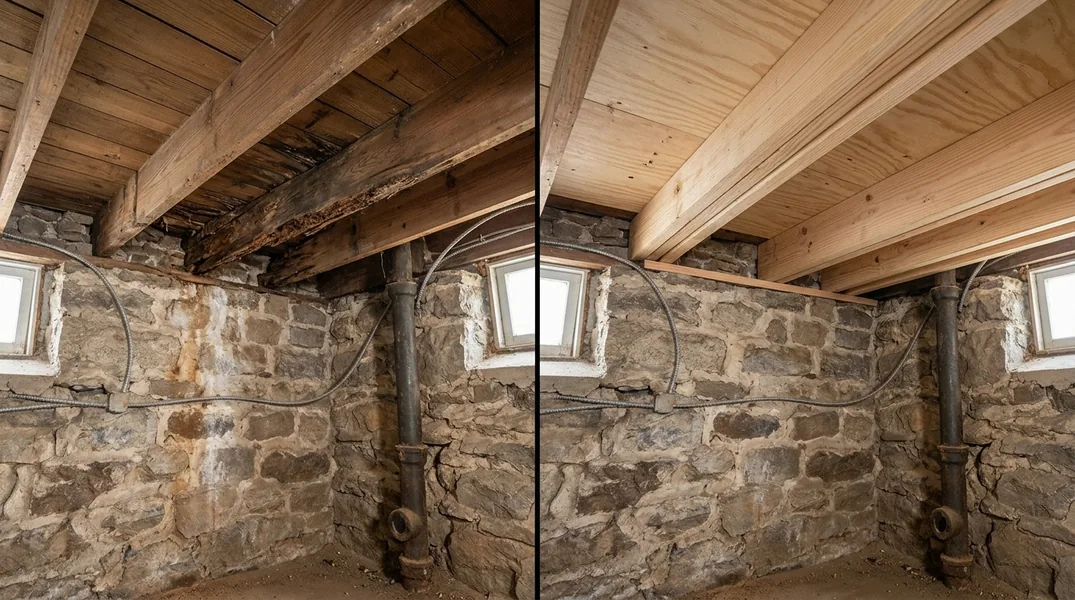
Why Are Your Floors Sagging? The Rockford Connection
If you own an older home in Rockford, you've probably noticed it: that subtle dip in the living room floor, or the way doors don't close quite right anymore. Sagging floors are one of the most common structural complaints we hear from homeowners across the region, and for good reason. Rockford's older housing stock, much of it built in the early to mid-20th century, sits on stone or rubble foundations that have spent decades settling unevenly. That settling, combined with moisture intrusion and wood decay, creates the perfect storm for floor failure.
The real culprit behind most sagging floors isn't just age, though. It's the slow, silent destruction of the structural members that hold your home up: the rim joists, band boards, and floor joists themselves. When these components fail due to Wood Rot & Dry Rot Repair or insect damage, the floor above has nothing to support it. The result is a noticeable sag that worsens over time if left unaddressed. Understanding what's happening beneath your feet is the first step toward getting a real fix.
Stone Basements and Foundation Settlement: The Hidden Problem
Many Rockford homes were built on stone or rubble foundations, a common practice before concrete became standard. These foundations, while solid in their day, are prone to uneven settling over the decades. Unlike a modern concrete foundation that settles uniformly, stone foundations settle in pockets and valleys. One corner might drop an inch while another remains stable, creating internal stress on the floor frame above. This differential settlement is especially pronounced in older neighborhoods where the soil has been undisturbed for over a century.
The problem compounds when moisture enters the picture. Basements in older homes often experience dampness, either from poor drainage, cracks in the stone, or high water tables. This moisture migrates upward into the rim joists and band boards, the wooden members that sit directly on top of the foundation. Over time, that constant moisture exposure causes wood to rot, lose its structural integrity, and eventually fail. By the time a homeowner notices the sagging floor above, the damage below may be decades in the making.
Rim Joist Rot Repair: Why This Component Matters So Much
The rim joist, also called the band board or rim board, is a critical structural element that most homeowners never think about until it fails. This wooden member sits on top of your foundation and serves as the perimeter frame for your entire floor system. It carries the weight of the exterior walls, supports the ends of the floor joists, and ties the entire foundation together. When rim joist rot develops, you're not dealing with a cosmetic issue, you're facing a fundamental threat to your home's structural stability.
Rim joist rot happens because this component is uniquely vulnerable to moisture. It's directly exposed to the foundation, often in contact with damp soil or concrete, and it's frequently the first wooden member to encounter rising moisture from basements. Once rot takes hold, it spreads quickly. The wood loses density and strength, can no longer support the floor joists properly, and begins to sag. In severe cases, the entire floor frame can shift or collapse. This is why addressing rim joist rot early is so important. If you suspect your rim joists are compromised, don't wait. Contact Rockford Carpentry at (815) 706-6970 for a thorough inspection and free estimate.
Floor Joist Repair and Sistering: What You Need to Know
Floor Joist & Subfloor Repair is often the most effective solution for sagging floors caused by weakened or damaged joists. Floor joists are the horizontal beams that run perpendicular to your rim joists and directly support your subfloor and finished flooring. When these joists become compromised by rot, insect damage, or overloading, they sag under the weight they carry. The good news is that damaged joists don't always need to be replaced entirely. A technique called sistering floor joists can restore strength and eliminate the sag.
Sistering involves installing a new, sound floor joist alongside the damaged one, fastening them together so they act as a single, stronger unit. This approach is cost-effective, minimally invasive, and highly effective for joists that still have some structural integrity remaining. The new joist shares the load with the old one, and over time, hydraulic jacks can be used to gradually lift the sagging floor back to its original level. For joists that are severely rotted or damaged beyond repair, full replacement is necessary. Either way, professional assessment is essential to determine which approach will work best for your situation.
Termite Damage and Other Wood-Destroying Insects
While rot is the most common cause of sagging floors in Rockford, Termite Damage Repair is another critical concern homeowners should understand. Termites and other wood-destroying insects can silently hollow out floor joists, rim joists, and band boards from the inside out. A joist might look solid on the surface while being completely compromised internally. This type of damage is particularly insidious because it often goes unnoticed until the floor begins to sag noticeably.
The Midwest is home to several species of wood-destroying insects, and older homes with stone foundations and damp basements are especially vulnerable. If you suspect insect damage, it's critical to have a professional inspection before attempting any repairs. Treating the underlying infestation is just as important as fixing the structural damage. Rockford Carpentry can identify the type of damage present and coordinate with pest control professionals if needed, ensuring your repair holds up for decades to come.
Getting Professional Help: Sagging Floor Repair Near Me
Sagging floors are not a DIY project. The structural systems involved are complex, and mistakes can be dangerous and expensive. A professional inspection is the essential first step. A qualified carpenter will assess the foundation settlement, inspect for rot and insect damage, measure the extent of the sag, and determine whether the issue is localized or systemic. They'll also check for any active moisture problems that could cause future damage. This comprehensive evaluation allows for a targeted repair plan rather than guessing at the problem.
Rockford Carpentry specializes in diagnosing and repairing sagging floors in older homes throughout the Rockford area, including Loves Park and Machesney Park. We understand the unique challenges posed by stone foundations, older construction methods, and decades of settling. Whether your floor needs sistering, full joist replacement, rim joist repair, or Beam Replacement & Load-Bearing Wall Removal, we have the expertise to handle it. Call us at (815) 706-6970 or visit our website to request a free estimate and learn more about pricing for your specific situation.
Looking for a professional carpentry contractor in Rockford? Rockford Carpentry responds fast for all your carpentry needs.
Get a Free QuoteOur services: Wood Rot & Dry Rot Repair · Termite Damage Repair · Floor Joist & Subfloor Repair