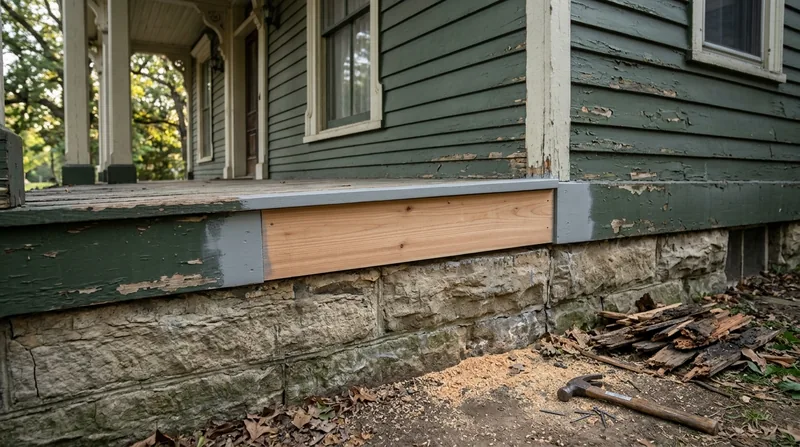




Wood Rot & Dry Rot Repair in Rockford starts with understanding why this city's climate and building stock create the conditions for decay. Rockford's winters bring hard freeze-thaw cycles, ice dams that back water into fascia and soffits, and snowmelt that saturates sill plates and rim joists. Summers are humid, and the Forest City's mature oaks and maples shade porches and north-facing trim, keeping them damp for weeks after rain. The Victorians and Colonials of Haight Village, the bungalows of Churchill's Grove, and the frame cottages around Seventh Street all sit over basements that wick moisture upward through fieldstone and limestone foundations. We cut out decayed framing, siding and trim, treat the surrounding wood, and rebuild with rot-resistant lumber, a permanent repair, not a cosmetic patch. If you're seeing soft spots in window sills, spongy porch floors, or dark staining on exterior trim, that's decay at work, and the sooner it's addressed, the less structural wood you lose.
Why Wood Rot and Dry Rot Damage Spreads Faster in Rockford's Climate
Rockford's geography and weather create perfect conditions for wood decay. The Rock River, Keith Creek, and the Kishwaukee wind through the city, and low ground near them floods in wet springs, raising the water table and pushing moisture into basements and crawlspaces. Winter ice dams trap meltwater against fascia and trim; spring thaws saturate the soil around foundations; and the city's dense tree canopy keeps porches and north-facing siding shaded and damp far longer than they dry. Decay doesn't happen overnight, but it compounds quickly once moisture penetrates the wood grain.
- Freeze-thaw cycles crack caulk and sealants, allowing water to enter window sills and door casings where it spreads into the framing behind.
- Ice dams push meltwater under fascia and soffit, saturating the rim joist and band board that sit directly above the foundation wall.
- Humid summers and shaded porches keep wood moisture levels above 20 percent, the threshold where decay fungi become active.
- Older stone foundations in Haight Village and Midtown wick groundwater upward, keeping sill plates perpetually damp unless protected by a moisture barrier.
The longer wet wood sits, the faster decay spreads through the grain and into adjacent framing. Early intervention stops that progression and preserves the structural integrity of the house.
Key info: A porch floor in Rockton or Loves Park that feels soft underfoot or shows black staining has likely been wet for months. Waiting for it to "dry out on its own" rarely works in our climate. We assess how deep the decay runs and whether the wood can be salvaged or must be replaced.
For more context on how moisture and decay interact with Rockford's building stock, see our guide to Floor Joist & Subfloor Repair, which often accompanies rot damage in basements and crawlspaces.
How We Repair Wood Rot and Dry Rot: A Step-by-Step Process
Our repair method is straightforward and built on honest assessment. We start by probing the affected wood to determine how far decay has penetrated, then map out exactly what needs to come out and what can stay. If the rot is confined to the outer inch or two and the structural wood underneath is solid, we cut away the decay, treat the perimeter with a wood preservative, and rebuild with pressure-treated or naturally rot-resistant lumber that matches the original profile. If the decay runs deep through a beam, joist, or sill plate, we sister new framing alongside it or replace the section outright, depending on load and access.
- We probe the wood with a screwdriver or awl to feel for soft spots and trace the full extent of decay before making any cuts.
- We cut away all visibly decayed wood, removing a safety margin into solid wood to ensure no hidden decay remains behind.
- We treat the exposed wood and framing with a borate-based wood preservative to kill any remaining fungal spores and protect adjacent sound wood.
- We rebuild the removed section with pressure-treated lumber, redwood, or Douglas fir, selecting the species based on the original material and the exposure.
- We seal all new wood with a quality exterior stain or paint to shed water and prevent future moisture entry.
- We address the source of the moisture: resealing window frames, repairing flashing, clearing gutters, or improving drainage around the foundation.
This approach preserves the character and structure of older homes while ensuring the repair lasts decades, not seasons.
Local example: A 1920s bungalow in Belvidere had soft spots in the porch floor and black staining on the rim joist where winter ice dams had backed water into the rim board. We removed the decayed rim joist and band board, sister-bolted new pressure-treated lumber alongside the remaining sound sections, rebuilt the porch floor with pressure-treated joists and subflooring, and installed new flashing at the rim to redirect water away from the foundation. The porch is now structurally sound and will shed water for decades.
For larger structural issues involving floor joists or subfloor, see Framing & Structural Carpentry.
Wood Rot and Dry Rot Repair Methods: Repair vs. Replace
| Approach | Description | Best for |
|---|---|---|
| Decay removal and surface rebuild | Cut out rotted wood, treat perimeter, rebuild surface layer with new lumber matching original profile and species. | Shallow rot in trim, siding, window sills, or porch fascia where structural wood underneath is sound and load-bearing capacity is not compromised. |
| Sistering and reinforcement | Bolt new framing (joists, beams, sill plates) alongside decayed members, distributing load across both old and new wood while preserving the original structure. | Decay in load-bearing rim joists, floor joists, or structural beams where replacement is not feasible due to access, cost, or historic preservation. |
| Complete section replacement | Remove the entire decayed member and install new pressure-treated or rot-resistant lumber, with new fasteners and flashing to prevent future moisture entry. | Decay that extends deep into load-bearing wood, spans multiple joists or beams, or affects the integrity of the structure in a way that sistering cannot adequately address. |
| Moisture source mitigation | Repair or install flashing, regrade soil, clear gutters, seal window frames, or improve basement drainage to stop water from reaching the wood in the first place. | All repairs, as a preventive measure. If the moisture source is not addressed, decay will return to the new wood within a few years. |
Wood Rot & Dry Rot Repair Cost in Rockford: What to Expect
Wood Rot & Dry Rot Repair cost in Rockford typically starts at around $650 for small, accessible jobs such as removing decay from a window sill, porch trim, or fascia and rebuilding the surface with new lumber. Larger projects involving rim joists, floor joists, or structural beams can run $1,500 to $4,000 or more, depending on how much wood must be removed, whether sistering or full replacement is needed, how accessible the work is, and whether the surrounding framing is sound or also decayed. A porch floor that has rotted through multiple joists and the subfloor will cost more than surface decay on trim because it involves more material, more labor, and structural considerations that may require engineering.
The main factors that move the cost up or down are the size and depth of the decay, the species of replacement lumber, access (a rot repair inside a crawlspace takes longer than one on an exterior wall), and whether the source of the moisture must be addressed at the same time. Getting 2 or 3 estimates from local carpenters is smart because the scope and method can vary based on what the wood reveals once we start cutting. Visit our pricing page for a full breakdown of our rates and what they include.
We charge $75 per hour for labor on most rot repairs, with a one-hour minimum for small jobs. Material costs are added on top and billed at cost plus 15 percent. Travel within Rockford and the surrounding areas (Loves Park, Machesney Park, Belvidere, Roscoe, Rockton, Cherry Valley) is included; there is no separate mileage fee. An on-site estimate is free and takes about 30 minutes; we can usually give you a ballpark price on the phone if you describe the damage and the location clearly.
Wood Rot & Dry Rot Repair Near Me: What Rockford Homeowners Should Know When Hiring a Carpenter
Choosing the right carpenter for a wood rot repair matters more than price alone. You want someone who will diagnose the problem honestly, explain what can be repaired versus what must be replaced, and address the moisture source so the decay doesn't come back. Before you hire, verify that the contractor is fully insured (ask to see a certificate of insurance), check references from recent rot or structural jobs, and get at least two estimates so you understand the range of approaches and costs in your market. If the job is large or involves a load-bearing wall, beam, or floor system, ask whether a permit is required and whether the contractor will help you coordinate with the local building department. Many rot repairs in older homes do not require a permit, but some do depending on the scope and the city or township where the work is done.
- Ask the contractor to explain why they are recommending repair, sistering, or replacement, and what the trade-offs are in terms of cost, durability, and appearance.
- Request references from homeowners in Rockford, Loves Park, or Belvidere who have had similar rot repairs done in the past year or two.
- Confirm that the contractor will address the moisture source (flashing, gutters, drainage, sealing) as part of the job, not as an afterthought.
- Ask whether a permit is required for your specific job and which city or township department issues permits for carpentry work in your area.
- Get a written estimate that itemizes labor, materials, and the scope of work, including what surfaces will be finished and what species of lumber will be used.
A carpenter who takes time to probe the wood, explain the decay pattern, and discuss options with you is one who will deliver a repair that lasts.
Wood Rot & Dry Rot Repair in Rockford: Pricing Guide
| Service | Price | Details |
|---|---|---|
| Window sill or trim decay removal | Starting at $650 | Includes cutting out soft wood, treating perimeter, rebuilding with rot-resistant lumber, and sealing. Small accessible jobs only. |
| Porch floor or fascia repair | Starting at $1,200 | Includes removal of decayed joists or rim board, sistering or replacement with pressure-treated lumber, new subfloor or fascia, and flashing repair to stop water entry. |
| Rim joist or band board repair | Starting at $1,800 | Structural repair involving sistering or replacement of load-bearing rim joist or band board, treatment of perimeter, and moisture mitigation at the foundation line. |
| Complex structural decay or large floor system | On estimate | Decay affecting multiple joists, beams, or subfloor systems requires on-site inspection to determine whether sistering, full replacement, or engineered repair is necessary. |
| Travel and estimate | Included / Free | No mileage fee within Rockford, Loves Park, Machesney Park, Belvidere, Roscoe, Rockton, Cherry Valley. Free estimate within 24 hours. |
Indicative pricing, the exact cost depends on square footage, finish, and site access. Free personalized estimate within 24h at (815) 706-6970.


